Home
/ Impulse Dimensional Formula Of Momentum - Paul Hasteral , X and y), the momentum will be conserved in each direction independently (as long as there's no external impulse in that direction).
Impulse Dimensional Formula Of Momentum - Paul Hasteral , X and y), the momentum will be conserved in each direction independently (as long as there's no external impulse in that direction).
Impulse Dimensional Formula Of Momentum - Paul Hasteral , X and y), the momentum will be conserved in each direction independently (as long as there's no external impulse in that direction).. The impulse resulting from the thruster. In this equation is the. Both force and time applied are directly related to impulse. The impulse experienced by an object is the force•time. There is a simpler formula for impulse which indicates it as the product of.
The formula is given as follows: As you do, keep these three major truths in mind: I m p u l s e = f o r c e × t i m e The impulsive forces will be zero in this case because there is no energy lost (e=1) during the collision. The dimensional formula for impulse is same as the dimensional formula for (1) momentum (2) force (3) rate of change of momentum (4) torque
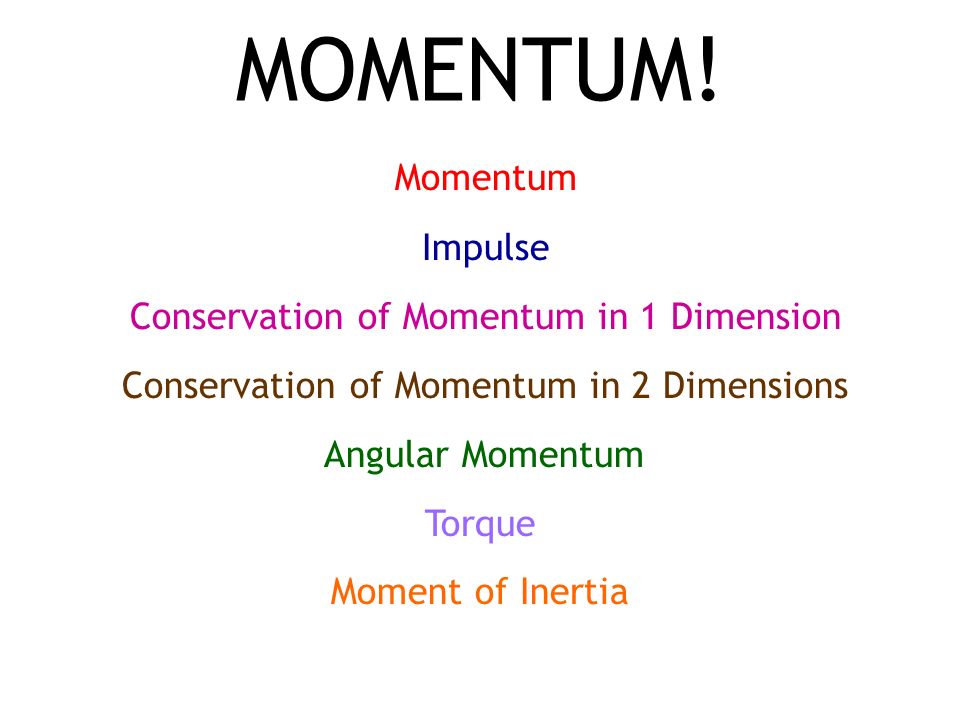
Momentum Momentum Impulse Conservation Of Momentum In 1 Dimension Ppt Video Online Download from slideplayer.com When a large force works on a body for a very small time interval, it is called impulsive force. The left side of the equation (f. As you do, keep these three major truths in mind: Which states that the total force acting on a particle is equal to the time rate of change of its linear momentum. As we saw earlier, this is exactly equivalent to a change in momentum. Impulse = force $\times$ time. A body moves completely in rotational motion. Momenta) is the product of the mass and velocity of an object.
Impulse (j) = ( m a).
Which states that the total force acting on a particle is equal to the time rate of change of its linear momentum. The impulse equals the momentum change. The impulse resulting from the thruster. Impulse dimensional formula of momentum / dimensional formula for angular momentum. \(\vec i = \mathop \smallint \limits_{{t_1}}^{{t_2}} \vec f \cdot dt\) Impulse is a term that quantifies the overall effect of a force acting over time. Impulse f t = δ p where f is the force exerted in a time t during a change in momentum, δ p, and where δ p = m v 1 − m v 2, where v 1 and v 2 are the object's velocities and m is its mass. There is a simpler formula for impulse which indicates it as the product of. Momenta) is the product of the mass and velocity of an object. A body moves completely in rotational motion. Impulse, and the right side is the. Impulse is simply the change in momentum. In this case, we simply need to break all forces and velocities into x and y components.
Now, putting the value of eq (2) and (3) in eq (1), we get the dimensional formula of impulse as: Angular impulse is equal to total change in angular momentum of the system in given time. The momentum change of an object is the mass•velocity change. The impulse is usually denoted by the variable j (not to be confused with the polar moment of inertia, which is also j) and the momentum is a body's mass times it's velocity. In other words, the total momentum in the x direction will be the same before and after the collision.
New Microsoft Office from s2.studylib.net k g m s − 1 = m l t − 1 6k views I m p u l s e = f o r c e × t i m e We take a look at impulse and momentum in two dimensions. Click the button to view answers. Impulse f t = δ p where f is the force exerted in a time t during a change in momentum, δ p, and where δ p = m v 1 − m v 2, where v 1 and v 2 are the object's velocities and m is its mass. Impulse, and the right side is the. Now, putting the value of eq (2) and (3) in eq (1), we get the dimensional formula of impulse as: Impulse is simply the change in momentum.
When a large force works on a body for a very small time interval, it is called impulsive force.
For a collision where objects will be moving in 2 dimensions (e.g. Angular impulse is equal to total change in angular momentum of the system in given time. Both force and time applied are directly related to impulse. In this case, we simply need to break all forces and velocities into x and y components. I m p u l s e = f o r c e × t i m e In other words, the total momentum in the x direction will be the same before and after the collision. Impulse changes the momentum and the equation is j = ft. →j = m →vf − m→vi j → = m v f → − m v i → Impulse = force $\times$ time. As you do, keep these three major truths in mind: The formula is given as follows: Modest force which means we get to use conservation of momentum for our system so was this going to look like well the momentum formula is mass times velocity so the initial momentum of the system let's see i'd have to add up initial momentum of the orange is 0.4 kilograms that's the mass times the. The impulsive forces will be zero in this case because there is no energy lost (e=1) during the collision.
Velocity is given by displacement over time, (v = d t), so, its dimensional formula is l t − 1. The impulse equals the momentum change. Modest force which means we get to use conservation of momentum for our system so was this going to look like well the momentum formula is mass times velocity so the initial momentum of the system let's see i'd have to add up initial momentum of the orange is 0.4 kilograms that's the mass times the. Impulse, and the right side is the. Impulse is expressed mathematically as :
Need Explanation For Out Of The Following Pairs Which One Does Not Have Identical Dimensions Is from i.ytimg.com In this case, we simply need to break all forces and velocities into x and y components. A body moves completely in rotational motion. Mass times change in velocity. Impulse = force $\times$ time. Also, the total momentum in the y direction. Momentum (m) = mass × velocity. The impulse experienced by an object is the force•time. According to si system unit of impulse will be newton second or
Principle of linear impulse and momentum imagine now that the force considered acts on the particle between time t 1 and time t 2.
Angular impulse is equal to total change in angular momentum of the system in given time. In this portion, we will learn about the rotational motion of the objects. In other words, the total momentum in the x direction will be the same before and after the collision. Impulse is simply the change in momentum. In such a case, we measure the total effect of force. Δ p = f δ t. A body moves completely in rotational motion. Modest force which means we get to use conservation of momentum for our system so was this going to look like well the momentum formula is mass times velocity so the initial momentum of the system let's see i'd have to add up initial momentum of the orange is 0.4 kilograms that's the mass times the. They will have the same dimensional formula since they both express momentum. Thus, impulse acts when a large force acts for a concise time duration to bring a finite change in the body's momentum, and the force acting on the body is called impulsive force or force of impulse. The impulse is usually denoted by the variable j (not to be confused with the polar moment of inertia, which is also j) and the momentum is a body's mass times it's velocity. As you do, keep these three major truths in mind: Velocity is given by displacement over time, (v = d t), so, its dimensional formula is l t − 1.
In such a case, we measure the total effect of force impulse dimensional formula. When a large force works on a body for a very small time interval, it is called impulsive force.

, the momentum will be conserved in each direction independently (as long as there's no external impulse in that direction).)